*** JUST INTRODUCED IN TIME FOR 250 YEAR CELEBRATION***Understand Money the Way the Constitution Intended
Six modules of primary-source, Socratic instruction — the Constitution, the Federal Reserve Act, the UCC, the IMF Articles of Agreement — so you can see the debt-money system clearly, navigate it confidently, and never be misled by a conspiracy theory or a banker's talking points again.

"I will hand you the primary sources, walk through them with you line by line, and trust you to handle the truth — because you can."— John-Edward
What you'll learn
What you'll be able to do
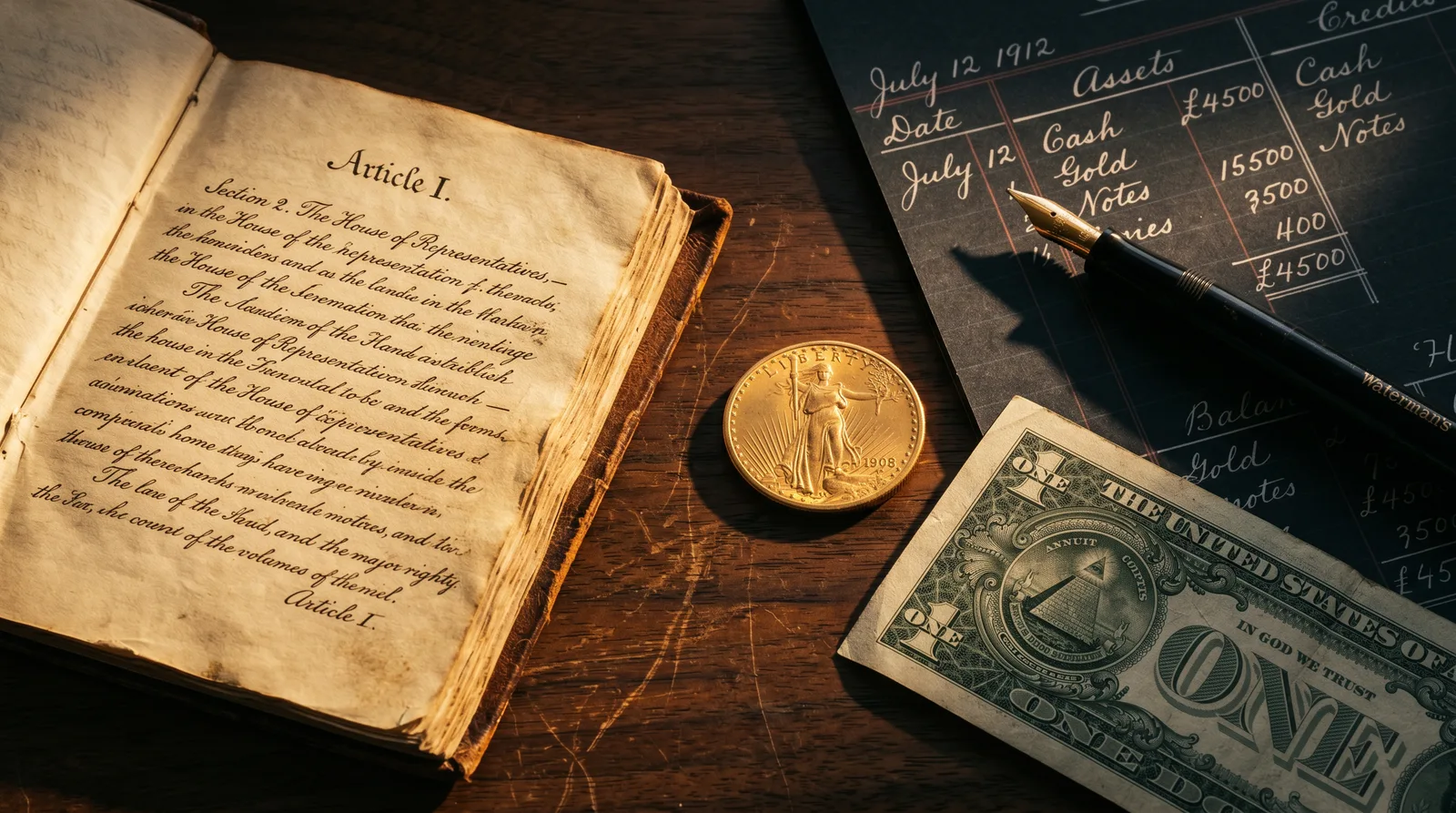
- Explain the constitutional definition of money — including the Coinage Act of 1792 and Article I, Section 10 — and contrast it precisely with what circulates today
- Trace the key historical inflection points (1913 Federal Reserve Act, 1933 gold confiscation, 1971 Nixon Shock) that severed the U.S. dollar from lawful money
- Describe the structure, ownership, and legal status of the Federal Reserve, the IMF, and the Bank for International Settlements — and how they interrelate
- Analyze what actually occurs on a bank's balance sheet when a mortgage, car loan, credit card, or student loan is originated — including the role of your promissory note as an asset
- Distinguish between a Federal Reserve Note as a debt instrument and constitutionally lawful money, and articulate the legal and practical implications of that distinction for living individuals
- Apply practical, grounded strategies for navigating contracts, banking relationships, and daily financial life with full knowledge of the debt-money system — without falling into pseudolegal traps
How it works
A school that adapts to you
This isn't a set of static videos. Every lesson is generated live and tuned to where you actually are.
We learn your level
A quick placement check tailors your starting point so you're never bored or lost.
Lessons adapt as you go
Each lesson is written for your pace and your goal, adjusting as your skills grow.
Your AI coach keeps you moving
Checkpoints, feedback, and gentle nudges turn progress into a real result.
The curriculum
What's inside your school
6 modules · 17 lessons

What Is Money? The Constitutional Foundation
Establishes the bedrock conceptual and legal vocabulary students need before any historical or institutional analysis can land meaningfully. By the end of this module students can precisely define money in its constitutional sense, distinguish it from modern currency, and identify the specific legal texts that anchor that definition.
- 1.1Money Through the Ages — Commodity, Token, and PromiseIncluded
- 1.2The Constitutional Text — Article I and the Coinage Act of 1792Included
- 1.3Lawful Money vs. Legal Tender — A Critical DistinctionIncluded
How Lawful Money Was Replaced — The Three Inflection Points
Traces the three pivotal legislative and executive actions that progressively severed the U.S. dollar from its constitutional gold-and-silver anchor. Students develop a cause-and-effect chain across six decades, understanding not just what happened but the legal mechanisms, political pressures, and monetary consequences of each rupture.
- 2.1The Federal Reserve Act and the Birth of Elastic CurrencyIncluded
- 2.2Executive Order 6102, Gold Confiscation, and HJR-192Included
- 2.3Nixon Shock, the Petrodollar, and the Pure Fiat EraIncluded
The Architecture of Control — The Fed, the IMF, and the BIS
Maps the institutional superstructure of the global debt-money system — who these entities are, how they are legally constituted, who owns or controls them, and how they interrelate. Students develop an accurate, evidence-based picture of these institutions, avoiding both naive acceptance of official narratives and unsupported conspiratorial claims.
- 3.1The Federal Reserve — Structure, Ownership, and Legal StatusIncluded
- 3.2The IMF and the SDR — Global Monetary GovernanceIncluded
- 3.3The Bank for International Settlements — The Central Bank of Central BanksIncluded
The Alchemy of Credit — What Actually Happens When a Bank Issues a Loan
This is the mechanical core of the course. Students learn, with balance-sheet precision, that commercial banks do not lend pre-existing deposits — they create new money by simultaneously booking a borrower's promissory note as an asset and the loan proceeds as a deposit liability. Students apply this understanding to mortgages, auto loans, credit cards, and student loans, developing a rigorous, evidence-based account of credit-money creation.
- 4.1How Banks Actually Create Money — The Bank of England AdmissionIncluded
- 4.2Mortgage Origination — Your Promissory Note as a Bank AssetIncluded
- 4.3Credit Cards, Auto Loans, and Student Loans — The Same Alchemy, Different WrappersIncluded
Federal Reserve Notes — Debt Instruments, Legal Implications, and the Fraud Question
Brings the legal and moral analysis to a head. Students examine the precise legal nature of a Federal Reserve Note as a non-redeemable liability of the Federal Reserve System, analyze the rigorous legal definition of fraud and whether the debt-money system meets that standard, and develop a grounded, intellectually honest position on the ethical and legal status of the current monetary system — avoiding both naive acceptance and pseudolegal overreach.
- 5.1Federal Reserve Notes as Debt Instruments — The Legal AnatomyIncluded
- 5.2Is It Fraud? — A Rigorous Legal and Ethical AnalysisIncluded
Navigating the System — Practical Sovereignty Without Pseudolegal Traps
Translates everything learned into grounded, legally accurate, and practically actionable guidance for living within the debt-money system. This module is explicitly designed to equip students with real tools while clearly delineating the difference between legitimate legal strategies and pseudolegal approaches (sovereign citizen, redemption theory, UCC strawman) that have resulted in contempt sanctions, criminal prosecution, and financial harm to those who have relied on them.
- 6.1Pseudolegal Traps — What Does Not Work and WhyIncluded
- 6.2What the Law Actually Allows — Rights, Remedies, and Red LinesIncluded
- 6.3Practical Financial Navigation — Contracts, Banking, and Debt with Full AwarenessIncluded
Who it's for
Is this you?

The Constitutional Researcher
You've read Article I and the Coinage Act and you want a structured, sourced curriculum that takes the constitutional text as seriously as you do.

The Skeptical Homeowner
You signed a mortgage and something felt off — this school gives you the balance-sheet and legal vocabulary to understand exactly what happened the moment you handed over that promissory note.

The Recovering Rabbit-Holer
You've been through the sovereign-citizen forums and the redemption videos and you want the real, grounded legal analysis — what actually holds up and what does not.

The Libertarian Policy Thinker
You care about sound money, Austrian economics, and the Federal Reserve's structural role — and you want primary-source depth, not talking points.

The Financially Curious Educator
You teach history, civics, or economics and you want a rigorous, sourced account of 1913, 1933, and 1971 that you can verify and build on.

The Everyday Financial Navigator
You're not an activist — you're someone who carries a credit card, has a car loan, and simply wants to understand what is actually happening in those transactions so you can make clearer decisions.
Questions
Frequently asked
Your teacher
A note from your teacher
John-Edward
If you are reading this, you have probably already sensed that something does not add up.
You have signed loan documents without being told that your signature — your promissory note — was recorded as an asset on the bank's balance sheet the moment you handed it over. You have used Federal Reserve Notes your whole life without being shown the constitutional text that defines what money is supposed to be, or the precise series of legislative and executive acts that severed the dollar from that definition. You have perhaps stumbled onto communities that were asking the right questions but offering answers that were legally reckless, and you walked away correctly skeptical — but still without the grounded knowledge you were looking for.
That gap is exactly what this school is built to close. I am not here to tell you what to think. I am here to hand you the primary sources — Article I, the Coinage Act of 1792, the Federal Reserve Act of 1913, Executive Order 6102, the IMF Articles of Agreement, the Bank of England's own research bulletin on money creation — and walk through them with you, the way a constitutional law researcher walks through any text: slowly, precisely, and without pre-loading the conclusion. We will look at bank balance sheets together. We will read the legal anatomy of a Federal Reserve Note together. We will ask the fraud question together, apply the legal definition of fraud rigorously, and let the analysis speak.
I want to be direct about one thing, because I think you deserve directness: this school will not give you a magic remedy, a UCC filing strategy, or a method to extinguish your debts by claiming a secret Treasury account. I know those ideas circulate widely. I know they feel compelling when you first encounter them. I cover them in the final module — not to mock anyone who was drawn to them, but to show you precisely, legally, and factually why they do not hold up, and what the actual costs of pursuing them can be. Understanding the monetary system clearly enough to see its architecture is a genuine form of sovereignty. Pseudolegal shortcuts are a trap dressed as liberation, and I will not send you into one.
What I will give you is this: by the end of six modules you will be able to sit across from a banker, a mortgage officer, or a financial advisor and read the transaction they are describing at the level of the balance sheet, the statute, and the constitutional text. You will know where Federal Reserve Notes sit in the legal order and what that means practically for how you enter contracts and manage financial relationships. You will have a map — sourced, precise, and honest — of one of the most consequential systems in modern life. That knowledge is yours to keep, and no one can take it back.
Come with your questions. Bring your skepticism — of the banking system and of what you read in this school. That is exactly the disposition that makes the work worthwhile.
— John-Edward
Start your journey today
Join get instant access — learn at your own pace with an AI coach in your corner.
$59/mo
Recurring billing · cancel anytime
Secure checkout · Instant access
- 6 modules, 17 lessons
- AI-adaptive lessons tuned to your level
- Quizzes & checkpoints to lock in progress
- Your own AI learning coach
- Learn on any device, at your pace
- Full access for as long as you're subscribed